

A soundbox announcement is a notification, not a settlement record and can lead to a soundbox fraud .It can be imitated by a Bluetooth speaker or a spoofed app, and because nothing is debited from you, bank reversal and liability rules do not apply. Only a credit in your linked account is proof. Report a fake alert on 1930.
What does a soundbox actually confirm?
A soundbox is a speaker with a SIM card. When a customer pays to your QR code, your payment service provider receives the transaction message and pushes a notification to the device, which reads the amount aloud. The device does not see the money or query your bank. It is told what to say, and it says it.
The audio sits at the far end of a chain. The payer’s bank debits the account, the network routes it, your bank credits your account, your provider records the transaction, and only then does the speaker make a noise. Every step before the noise is where settlement happens. The noise is the receipt, not the payment.
So nobody has to break into the payment network to make your counter say a payment arrived. They have to produce a sound: a recording on a phone, a speaker in a jacket pocket, a spoofed screen held up for two seconds. None of these touch the rails, and all of them touch the only signal most shopkeepers check.
The four confirmation channels, and what each one proves
Most counters have more than one way to confirm a payment, and treat them as interchangeable. They are not: they sit at different points in the chain and carry different weight.
| Channel | Where it sits in the chain | What it proves | How hard it is to fake |
|---|---|---|---|
| Soundbox audio | A push notification from your provider to a speaker | That something instructed the device to speak, or that a speaker nearby played a sound | Trivial. No access to any payment system is needed |
| Customer’s screen held up to you | The payer’s own device | Nothing you can verify. It is the other party’s claim about the other party’s app | Trivial. Editing apps and spoof apps both exist |
| Your provider’s merchant app | Your provider’s record of the transaction | That your provider received and logged a transaction against your account | Hard. It needs access to your own login |
| Bank SMS or passbook on the linked account | Your bank’s record of the credit | That money has actually reached your account | Hardest. SMS can be spoofed on a phone, but the passbook entry cannot |
The rule is short. Audio and the customer’s screen are claims. Your merchant app and your bank record are evidence. For a small payment a claim is good enough. For anything that would hurt to lose, move down the table.
The same logic applies to checking a payment screenshot and to a screen sharing scam. The question is never whether the thing in front of you looks convincing. It is whether it was produced by a system you control or by a system the other party controls.
How a fake confirmation reaches your counter and causes soundbox fraud
Four methods cover most of what merchants report.
| Method | What the fraudster does | What gives it away |
|---|---|---|
| Recorded audio played nearby | Plays a captured or synthesised announcement from a phone or a pocket speaker, timed to the moment you look up | The sound comes from the wrong direction or the wrong distance. Your own device shows no new entry |
| Spoofed notification on the payer’s screen | Shows a screen built to look like a successful payment, sometimes with your shop name on it | It is on their phone, not yours. There is no corresponding entry anywhere you control |
| An unfamiliar speaker left near the counter | Places a device that is not from your provider, which plays announcements on command | You did not receive that device from your provider. Check what is on your counter before you open |
| A sticker over your QR code | Covers your code with another one, so payments route to a different account while the shop still looks normal | Your own test payment does not arrive. Scan your own code once a day |
Note what the third row does not say. A speaker that plays an announcement is not a cloned soundbox, because it is not connected to the payment network at all, and calling it a clone sends merchants hunting a technical problem that does not exist. A device that did not come from your provider is not your device.
The fourth row is the only one where money actually moves, and it moves to someone else. That makes it the most damaging, because the customer has genuinely paid and you have genuinely not been credited, so it surfaces as an argument rather than a fraud report.
Why this is a cheating case and not a banking dispute
This is the part the usual advice gets wrong, and it costs merchants weeks.
When money leaves a bank account without authorisation, a specific framework applies: the customer notifies the bank, the bank carries the burden of proving liability, and there are timelines for reversal. It exists because an account was debited.
In a fake soundbox alert, no account is debited. There is nothing to reverse and nothing for a bank to investigate, because from the banking system’s point of view nothing happened. Goods left your shop because you were deceived. That is cheating, and a police matter.
The same distinction separates this from a UPI payment that failed after the money left the payer. Where a payer is genuinely debited and the beneficiary is not credited, the Reserve Bank’s turn around time circular requires auto reversal by the beneficiary bank by T plus one day, with Rs 100 per day of delay after that, credited on the bank’s own initiative without waiting for a complaint. Where confirmation does not reach the merchant location, the same circular allows T plus five days. Those rules have nothing to do with a fake alert, which produced no debit for anyone to reverse.
| What happened | Was an account debited | Which rules apply | Where it goes |
|---|---|---|---|
| Fake alert, goods handed over | No | None of the banking reversal or liability rules | Police, through 1930 or the cybercrime portal |
| Payer debited, you not credited | Yes | Auto reversal by T plus one day, Rs 100 per day after, paid without a complaint | The payer’s bank, and the Ombudsman if it is not done |
| QR sticker swapped, payment went elsewhere | Yes, to a third party | The payment succeeded, so reversal rules do not apply. It is cheating | Police, and your provider, to get the fraudulent code shut down |
| Money taken from your own account | Yes, yours | The unauthorised transaction framework, with the burden on the bank | Your bank, in writing, immediately |
Getting this right on day one matters. A merchant who spends four days arguing with a bank about a transaction that never existed has lost the window in which a police complaint could have done something.
What one fake alert actually costs a shop
The sticker price understates the loss, because goods are sold at a margin and the margin is what the shop keeps.
Take an illustrative case. A shop hands over goods worth Rs 4,200 against an alert that turns out to be fake, on a net margin of 8 per cent. The loss is not Rs 4,200 of profit. It is Rs 4,200 of stock to be replaced out of future profit, and at 8 per cent that takes Rs 52,500 of additional sales. At a 12 per cent margin it is Rs 35,000. These figures are illustrative, showing the shape of the arithmetic rather than any particular shop.
Set that against the cost of checking. A counter doing 120 UPI transactions a day, at a six second glance each, would spend 12 minutes a day on verification, about six hours a month. Nobody checks all 120 and nobody should. A shop that checks only above a threshold it sets spends a fraction of that and removes most of the exposure, because fraudsters do not take the trouble for small amounts.
If repeated counter losses have already been covered by drawing on a credit card, the shortfall has quietly become a revolving balance at card rates. That is a separate problem from the fraud itself, and it compounds faster. BillCut refinances high interest credit card balances into a single structured EMI at a lower rate, which is worth checking only if a card balance has built up. It does nothing about the soundbox on your counter.
What your payment provider owes you
Soundbox providers are not unregulated. Most operate as authorised non-bank payment system operators, payment aggregators, or both, and two sets of Reserve Bank directions apply to them.
The Cyber Resilience and Digital Payment Security Controls for non-bank PSOs Master Directions, 2024 require a real time or near real time fraud monitoring solution to identify suspicious transactional behaviour, online alerts on parameters including transaction velocity, time zone, geo location and IP address origin, and public awareness work on precautions against fraud. Cyber incidents must be reported to the Reserve Bank within six hours of detection. The directions apply in phases: large operators from 1 April 2025, medium from 1 April 2026, small from 1 April 2028.
The Regulation of Payment Aggregators Directions, 2025 cover aggregators at a physical point of sale, defined as transactions where the acceptance device and the payment instrument are both physically present. That is your counter. They require background and antecedent checks on merchants at onboarding, and an appointed officer responsible for responding to issues raised by merchants, with an escalation matrix on the aggregator’s website. That last point is the one to use. Find your provider’s escalation route before you need it.
On the banking side, the Digital Payment Security Controls Directions, 2021 require regulated entities to run fraud risk management with parameterised alerts and to send transaction alerts by SMS or email. The alert your bank sends is part of a regulated control. The sound your counter makes is not.
Where to report, and in what order
Order matters. The first two on the same day beat all five next week.
| Step | Where | What it achieves |
|---|---|---|
| 1 | Cybercrime helpline 1930, or the National Cybercrime Reporting Portal | Creates the record that everything else hangs off, and feeds the financial fraud reporting system |
| 2 | Your payment provider, through the escalation officer named on its website | Gets a fraudulent QR code taken down and the device checked, and triggers the provider’s own fraud monitoring |
| 3 | Chakshu, on the Sanchar Saathi portal | Reports the mobile number used, which feeds the risk scoring described below |
| 4 | Local police station, written complaint | Required for anything that will need an insurance claim or a prosecution |
| 5 | Reserve Bank Integrated Ombudsman Scheme, if a regulated entity will not act | Escalation above your provider or bank, after you have complained to them first |
The system behind step one is not decorative. The Ministry of Home Affairs recorded in August 2024 that the Citizen Financial Cyber Fraud Reporting and Management System had saved more than Rs 2,400 crore across more than 7.6 lakh complaints. The later note Curbing Cyber Frauds in Digital India puts it at more than Rs 5,489 crore across more than 17.82 lakh complaints, with more than 9.42 lakh SIM cards and 2,63,348 device identifiers blocked.
Step three is more useful than it looks. The Department of Telecommunications runs a Financial Fraud Risk Indicator, which classifies a mobile number as medium, high or very high risk of financial fraud using data from the Indian Cybercrime Coordination Centre, the Chakshu platform and financial institutions. PhonePe declines transactions from the very high band with an on screen warning, and Paytm and Google Pay have begun implementing alerts from the same platform.
Telling a fake alert apart from a slow one
Not every mismatch is fraud, and a merchant who treats every one as theft will accuse paying customers. The question is whether a debit exists. Ask to see the entry in the customer’s own bank statement or passbook, not their app’s success screen. If the account was debited, this is a settlement problem and the reversal timetable applies. If no debit exists, no payment was attempted and the announcement did not come from your provider.
Two practical markers. A genuine announcement is followed within seconds by an entry in your merchant app, whether or not the bank credit has landed, and a genuine payment leaves a reference number the customer can read out. A fake alert leaves nothing on your side. On which parts of the experience are set by the app and which by the bank, what genuinely differs between the UPI apps is the fuller picture.
A counter routine that costs twelve minutes a month and prevent soundbox fraud
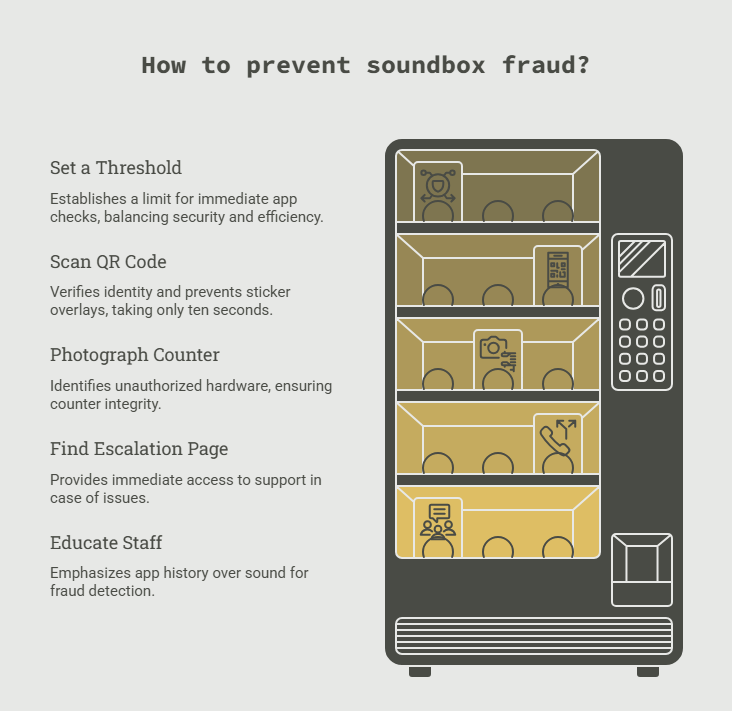
None of this needs new equipment. It needs a few habits and a threshold.
- Set an amount above which you always look at your merchant app before the goods leave. Pick a number that reflects what you can afford to lose in a day.
- Scan your own QR code each morning before you open and check the name it shows is yours. This is the only reliable defence against a sticker overlay and it takes ten seconds.
- Photograph your counter once, so you know what hardware belongs there. Anything that appears and is not in the photograph does not belong.
- Find your provider’s grievance escalation page now and write the name and number somewhere you can reach without a phone.
- Tell whoever else works the counter that the sound is not the proof, and show them where the merchant app history is.
A threshold beats a blanket rule because blanket rules fail under pressure. Check everything gets abandoned at six on a Saturday, and an abandoned rule is worse than a lower one that survives the rush. Shops that also take card or credit payments have a related set of checks, which QR credit at checkout covers.
Who needs to verify every payment, and who does not
Verification costs time and queue length, so it is worth being honest about who needs it.
Verify above your threshold if one loss would hurt, if goods leave the premises and cannot be recovered, if you sell items that resell easily such as electronics or phone accessories, if you work alone and cannot watch the counter and the customer at once, or if you have already had one incident.
You can rely on the audio if your typical sale is small, your stock is low value and slow to resell, the customer is known to you, or your counter is quiet enough that you glance at your screen anyway. A tea stall taking Rs 20 payments does not need a verification policy. A phone accessories counter taking Rs 3,000 payments does.
Frequently Asked Questions
-
Can a soundbox announcement be faked?
Not the genuine announcement, which would need access to your provider’s system. Fraudsters produce a similar sound from another source instead, usually a phone or a speaker near the counter. From where you stand the two are hard to tell apart, which is why the check is your screen rather than your ears.
-
If a fake alert played and I handed over goods, will the bank refund me?
No. Nothing was debited from your account, so there is no transaction to reverse and no unauthorised transaction framework to invoke. You were deceived into parting with goods, which is cheating. The complaint goes to the police through 1930 or the cybercrime portal, and to your provider.
-
What is the difference between this and a payment that failed?
A failed payment means the payer was debited and the money did not reach you. The Reserve Bank’s turn around time circular requires auto reversal by T plus one day where a beneficiary was not credited, and T plus five where the merchant did not get confirmation, with Rs 100 per day of delay after that. A fake alert produced no debit.
-
Someone put a sticker over my QR code. Who is responsible?
Those were genuine payments, so they will not be reversed. Report the code to your provider so it can be shut down, file a police complaint, and check your own code every morning before you open. Customers who paid the wrong code have a cheating complaint of their own.
-
How do I know a device on my counter is really from my provider?
Because you received it from them. Nobody arrives unannounced to leave a replacement, and no legitimate provider asks you to accept a device from a customer. Photograph your counter once so you know what belongs there, and treat anything unfamiliar as suspect until the provider confirms it.
-
Does my payment provider have any obligation here?
Yes. Under the Reserve Bank’s 2024 directions for non-bank payment system operators, providers must run real time or near real time fraud monitoring and report cyber incidents within six hours. Under the 2025 payment aggregator directions, an aggregator must appoint an officer responsible for merchant issues and publish an escalation matrix.
-
Is it worth reporting the fraudster’s mobile number?
Yes, on the Chakshu module of the Sanchar Saathi portal. The Department of Telecommunications runs a Financial Fraud Risk Indicator scoring mobile numbers as medium, high or very high risk, using data that includes Chakshu reports. PhonePe declines transactions from the very high band, and Paytm and Google Pay have begun implementing alerts from the same platform.
-
Should I stop using a soundbox?
No. It solves a real problem: a shopkeeper cannot watch a phone screen and serve customers at once. The fix is to stop treating its output as settlement. Use the sound to know something probably happened, and your merchant app to know that it did.
-
How much verification is enough?
Set one threshold and apply it. Below it, rely on the audio. Above it, look at your merchant app before the goods leave. A counter doing 120 transactions a day that checked every one at six seconds each would spend about six hours a month on it, which is why a threshold beats checking everything.
-
Where do I escalate if my provider does nothing?
Complain to the provider first, in writing, through the escalation route on its website. If that does not resolve it, the Reserve Bank Integrated Ombudsman Scheme covers banks, non-banking financial companies and non-bank system participants in digital transactions, with complaints received centrally and a contact centre on 14448.
This article is for general information and does not constitute financial, legal or security advice. Rules, timelines and provider obligations change. Check the current position with the Reserve Bank of India, your payment service provider and your bank before acting. Figures used in examples are illustrative.
Are you still struggling with higher rate of interests on your credit card debts? Cut your bills with BillCut Today!